What to Do With Your Dog’s Collar and Other Belongings After They Die
By PetMemorium
- Published:
- Last updated:
A collar can fit in the palm of your hand and still feel impossible to know what to do with.
You can keep your dog’s collar, leave it where it is, put it away for now, or eventually give away some of their other belongings. There is no deadline you need to meet, and you do not have to make the same choice for everything.
The collar might stay with you while a bulky bed goes into storage. A favorite toy might feel irreplaceable, while an extra bowl feels like something another animal could use.
Begin with one item and what you want to happen to it today. You can leave the rest undecided.
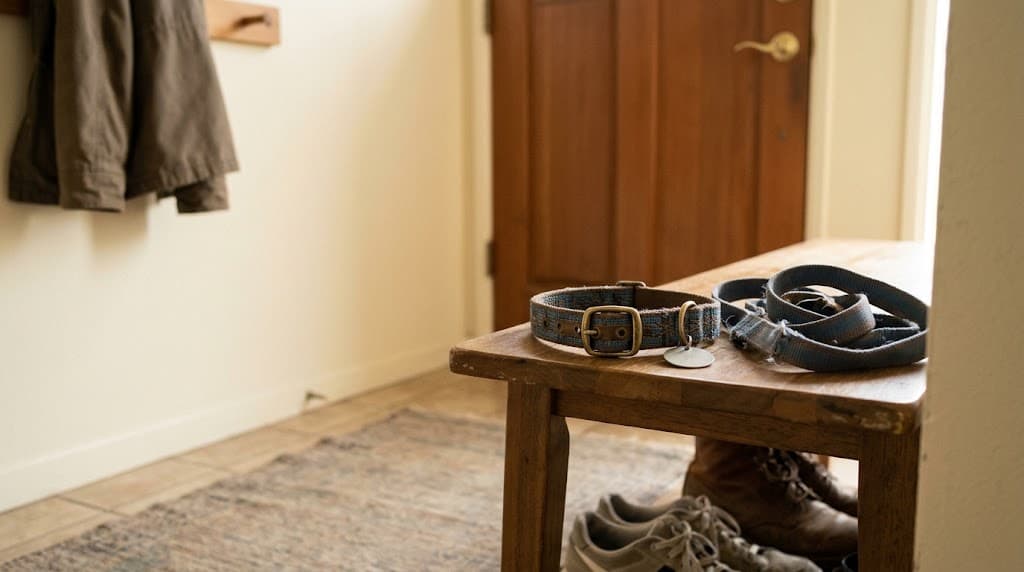
Why can leaving their things out—and putting them away—both hurt?
Seeing an empty bed can make the absence difficult to ignore. Moving it can leave a different kind of emptiness: the place where even the bed used to be.
A collar may bring back more than the dog who wore it. It can bring back reaching for your shoes, checking the weather, or waiting while your dog finished investigating something on the way outside.
Cornell’s pet-loss guidance describes both yearning for a pet and the adjustment to everyday life without them. It does not prescribe a schedule for clearing their belongings. Cornell University College of Veterinary Medicine: Stages of Grieving
You do not have to find an arrangement that makes none of this hurt. A more manageable question is: Would I rather have this particular thing nearby, or have a little distance from it right now?
The answer can be different tomorrow. It can also be different for the next object you pick up.
Make a separate choice for each item
You do not need to sort everything into “keep forever” and “get rid of.”
For any one belonging, consider these possibilities:
- Keep it accessible. You want to see it, hold it, or know it is close. Choose somewhere it will not be accidentally mixed into ordinary cleaning or a donation pile.
- Keep it, but out of sight. You want the original object, just not the repeated reminder of seeing it throughout the day.
- Consider passing it on. You are interested in someone else using it, but have not yet confirmed where it could go.
- Leave it undecided. You cannot tell what you want yet. That item does not need to join a sorting session simply because other things are being moved.
Think about the actual object, not what you believe you ought to feel about it.
The newest toy may mean very little to you. The old leash with the awkward handle may be the thing you recognize immediately. Cost, condition, and sentimental importance do not have to line up.
If choosing becomes too much, stop with the item already in your hand. Finishing the room is not the requirement.
If you put something away, make clear that you are storing it
“Out of sight” and “available to give away” are different decisions. Make that distinction clear, especially if someone else is helping.
Use a drawer or container you can identify later. You do not need to buy a special memory box. If several people share the home, a plain label can prevent a misunderstanding.
For example:
Collar and leash. Keeping these. Please ask before moving them.
That is an instruction about the objects, not a promise about how long you will feel this way.
If a friend is doing the packing, agree on the destination before they begin. Ask them to keep uncertain items separate rather than making choices on your behalf. Know where the belongings are going, and make sure you can get them back without having to explain why.
There is no need to schedule a day when you must open the container and reach a final decision. If you want a reminder to check it, choose one for your own convenience—not as a test of whether you are ready to let go.
A temporary arrangement can remain temporary.
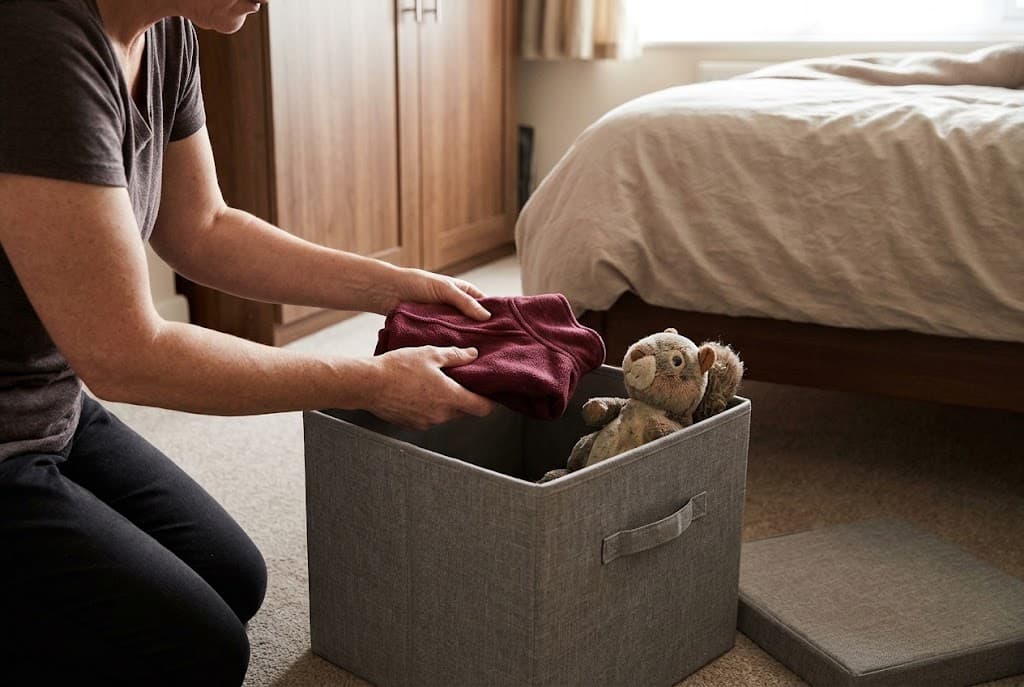
What can I do with the collar I want to keep?
Start with how you want to encounter it.
If you want to hold it sometimes, keeping it somewhere accessible may suit you better than attaching it permanently to a display. If you prefer to see it occasionally, it could sit beside a photograph or remain in a small container you choose when to open.
If you have already decided you want a display, our guide to pet shadow box ideas explores arrangements in more detail. You do not need to turn the collar into a project before it is worth keeping.
You can also keep the collar without the entire collection of walking equipment. Or keep the tag and store the rest. Choose what matters to you before choosing what it should look like.
If you already have a small clipping of your dog’s fur, that can be a separate decision. You could keep it in a labeled envelope or container so it is not mistaken for something to discard. You do not need to make it into jewelry, find a special product, or keep it simply because someone else would.
The same freedom applies to the collar: keeping it does not create an obligation to display it.
Keep the part the object cannot tell
An object can prompt a memory without explaining it.
Here is an invented example, not a story about a real owner: a dog stood sideways while their collar was fastened, then immediately checked the same coat pocket for a treat.
The collar alone would not tell you that. A few words from the person who remembers would.
If a detail comes readily, you can keep it with the object or in a separate note. If it does not, leave the description unfinished. You do not have to reconstruct an entire routine—or write anything at all—before deciding where the collar belongs.
For a fuller approach to recording those details, How to Keep Your Pet’s Memory Alive focuses on the memories themselves.
Can I donate some belongings and keep others?
Yes. You can keep something personally important and consider passing on other things that are still useful.
Giving away an extra bowl does not undo the meals you shared. Keeping the collar does not require you to keep every coat, bed, and spare leash.
Before packing anything for a shelter, rescue, or another household, ask the intended recipient what they currently accept. Describe the item and its condition, and confirm any cleaning or delivery requirements. Do not assume that every organization can use a particular bed, toy, or opened supply.
Keep items you are considering for donation separate from those you have actually decided to give. If you are not sure about one piece, leave it out of the handover.
You can also ask someone else to make the inquiry without authorizing them to take the belongings away.
A donation does not need to become a ceremony. Nor is it something you must do to turn the loss into a positive story. It can be a practical choice about one object, made when you want to make it.
What if my family disagrees—or another pet still uses the things?
Two people can want different things from the same room.
One person may want the bed out of sight. Another may feel distressed at the thought of coming home and discovering it gone.
Before changing a shared space, agree on what can move and what must not be given away without another conversation. A storage location everyone knows about can be a workable first step, even when you have not agreed on a permanent answer.
If space is limited or a move is approaching, name that practical constraint. You may need the floor clear by a particular day. That does not mean every belonging must leave the home by then. Work out which smaller things you want to keep, and ask for help with the part that genuinely cannot wait.
If another pet still uses a shared bed, bowl, or blanket, account for that before removing it. Make sure their everyday needs are covered. You can set aside one item for remembrance while other suitable belongings remain in ordinary use.
Reusing something does not have to mean replacing the pet who died. Keeping something aside does not mean you must buy a new version of everything, either.
These choices can apply to a cat’s carrier, blanket, or toys as well. The point is to consider the actual people, animals, and objects in your home—not a rule about what every grieving household should do.
You can decide where something belongs without deciding what the loss means
If the belongings are only one part of a day that feels difficult to manage, How to Cope With Pet Loss offers broader, everyday support. You do not have to solve the whole day by sorting a cupboard.
For now, the collar can stay where it is. It can also have a new place: somewhere you know, somewhere you can reach, somewhere it will not be mistaken for an unwanted thing.
That choice does not need to explain your grief to anyone.
You are deciding what to do with an object that belonged to your dog. You are not deciding how much the life you shared mattered.