Dog Shadow Box Ideas: What to Keep and How to Arrange It
By PetMemorium
- Published:
- Last updated:
A shadow box is a deep display frame or case with room for objects as well as pictures. To plan one for your pet, choose a familiar moment, pick a focal item, and add the pieces that help tell that story.
A walk that always began the same way. A game with very particular rules. The small interruption that meant your pet wanted you to stop working.
Choose that moment first. Then look for a few things you already have that belong to it.
You do not need a photograph, an elaborate collection, or an object that looks like a memorial. A worn, ordinary thing can carry a connection that a perfect matching set cannot.
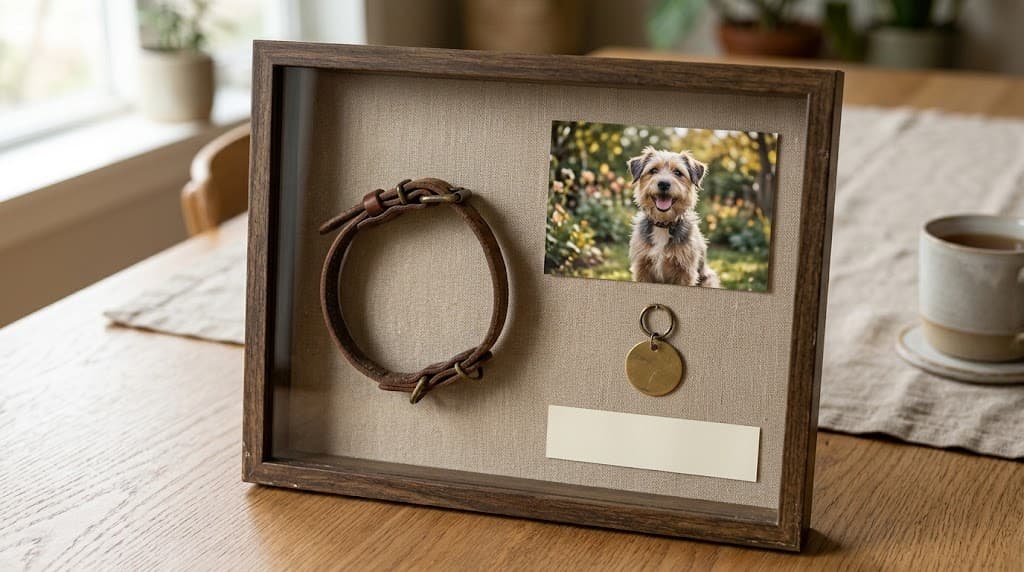
Start with a moment, not everything you saved
Before laying anything out, finish this sentence:
“When I look at this box, I want to remember…”
Be specific enough to help you choose. “Our walks before breakfast” gives you more direction than “everything about him.”
Then gather only the objects connected with that moment. You can return the rest to wherever you keep them. Leaving something out of this arrangement is not a decision to throw it away.
Choose one item as the focal point: the thing you would notice first. That could be a small toy, a tag, a photograph, or a written line about something you remember.
Other pieces should add something different. If two objects tell the same part of the story, try the layout with just one.
Test the arrangement before buying or attaching anything
Start on a table. Use a sheet of paper or an empty tray to mark out the space you might use. An existing display case may work, but you do not need to choose a permanent container yet.
Place the main object first. Add the supporting pieces one at a time, leaving visible space between them.
Now look from a little farther away. Can you tell what matters most? Does anything hide the detail that makes another item meaningful?
If the arrangement feels crowded, remove something before looking for a bigger box. A few carefully chosen pieces can be enough.
This is a way to plan the composition, not a guide to building a case or attaching objects. Check the particular case’s dimensions and instructions before making a final arrangement; do not assume that an item that fits across the back will also fit within its depth.
Three layouts built around three different memories
These are invented examples to show how the choices could work. Use the arrangement idea, not a story that does not belong to your pet.
A dog’s unhurried morning walk
Imagine a dog who always stopped at the same corner before choosing which direction to go.
A layout could place a small photograph on the right, with the dog’s tag below it. On the left, an actual collar could rest in a loose curve, if the case has enough room. Leave the upper-left area open rather than filling it with decoration.
A short caption underneath might say:
“You always stopped at the corner and waited for me to follow.”
The connection is not simply “dog plus collar.” It is the small pause that belonged to your walks together.
If the collar is too large or no longer available, leave it out. The photograph, tag, and true sentence can still carry the idea.
A cat’s particular way of playing
Suppose a cat had a small fabric mouse they would push beneath a cabinet, then sit beside until someone helped retrieve it.
Place the actual toy slightly off-center. Leave a generous clear area beside it so its worn shape is easy to notice. A small card near the lower edge could explain the game:
“Under the cabinet. Then you watched until I came over.”
A photograph is optional. If you have one of the cat playing, try it in a smaller supporting position rather than making it compete with the toy.
The object says what the cat played with. The sentence says how the two of you played together.
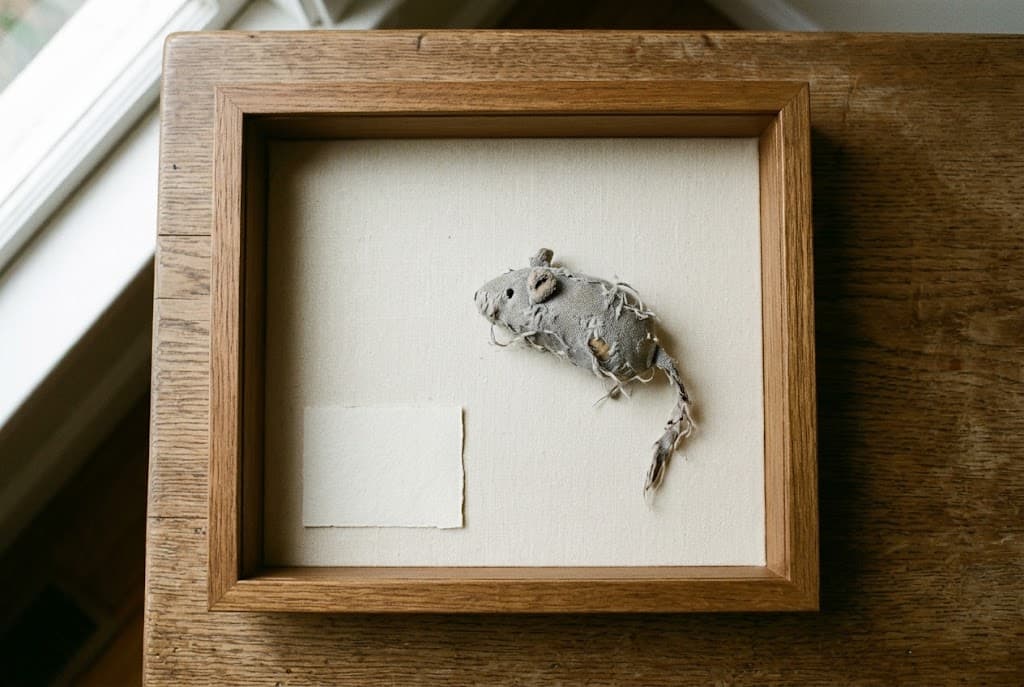
A familiar habit without a photograph
For another invented example, imagine a dog who carried a soft toy into the kitchen while dinner was being prepared.
The toy can be the main object, set to one side, with a short memory card on the other. Nothing needs to fill the space above them.
The card might read:
“You brought this into the kitchen and dropped it beside my feet while I cooked.”
There is no missing-photo space to disguise. This is a complete choice: one object, one remembered action, and enough room to see both.
If you want other ways to keep memories without pictures, Remembering My Cat Without Photos: What Can I Keep? offers a separate set of approaches beyond a display.
Let the caption say what the object cannot
A label such as “Favorite toy” identifies an item. A short sentence can preserve the part that was particular to your pet.
Write what you actually remember about this object. You do not need a polished tribute or an account of their whole life.
If a detail is uncertain, leave it uncertain. You can write “I remember you carrying this from room to room” without adding where you bought it or how old they were if you do not know.
Read the words aloud beside the objects. Keep the sentence that makes the connection clearer. You can save a longer story elsewhere without squeezing it onto the display.
Choose a place where the arrangement feels welcome
Before deciding where the box belongs, try the arrangement where you expect to see it. A private shelf may feel better than a busy hallway. Somewhere you notice occasionally may suit you better than a place you pass all day.
You can change your mind.
If the display will sit in a shared room, ask before including another person’s photograph, message, or contribution. A memory can be important without needing to be public.
You can also leave the project unfinished for a while. The objects do not need to become a display before they are worth keeping.
What makes the finished box recognizable is not how much you managed to include. It is the connection between the few things you chose.
A particular toy. A particular game. One small sentence that lets you see the moment again.