Songs About Losing a Pet: Meaningful Music to Remember Your Dog or Cat
By PetMemorium
- Published:
- Last updated:
Sometimes you want a song that understands the goodbye. Other times, you want something that reminds you there was a whole life before it.
A dog carrying something they were not supposed to have. A cat settling onto the laundry before you finished folding it. The music playing while you made dinner, with someone small waiting nearby.
If you are looking for songs about losing a pet, the five recordings below offer different starting points. Some have a direct connection to animals. Others belong here because bereaved pet owners have found their own memories in them.
You do not need a long playlist, and you do not have to choose the song that makes you cry hardest. One that feels right for a few minutes can be enough.
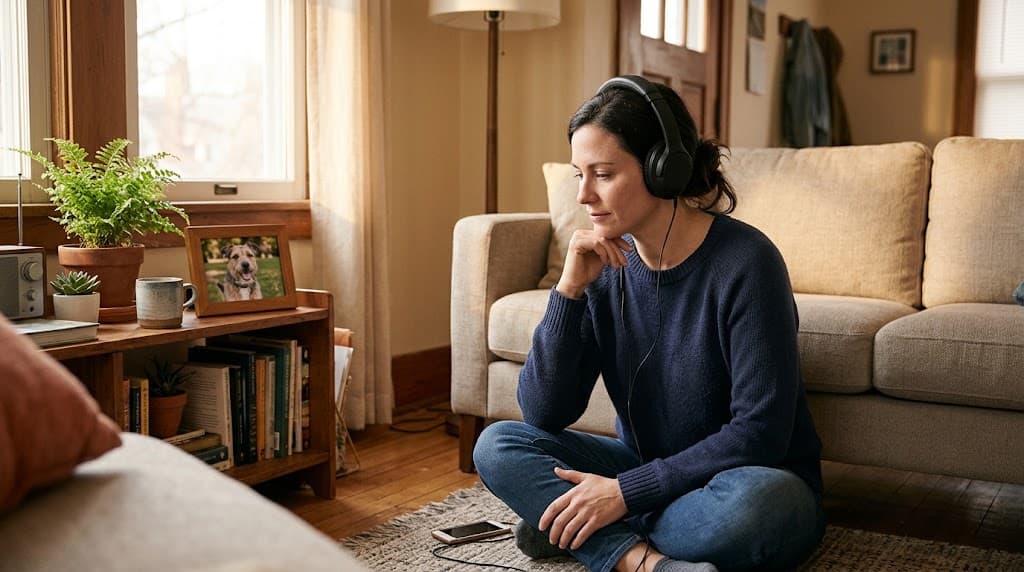
What do you want the song to hold?
Before choosing, ask yourself what you would like to remember—or what you need room to feel today.
You might want to hear someone tell the story of a dog’s life. You might want words for how abruptly the ordinary days ended. Or you might want to look at a happy photograph without making the moment entirely about loss.
Those are different listening needs. A song that fits one may feel wrong for another.
It also helps to separate a song’s original story from the meaning it has for you. You can connect a song with your pet without claiming the artist wrote it about an animal. Your connection can be personal and true even when it is not the songwriter’s original subject.
Two songs with animals in their stories
“Maggie’s Song” — Chris Stapleton
This is a clear starting point if you want a song genuinely written in memory of a dog. Stapleton told NPR that he wrote it the day after his dog Maggie died. The interview is available through Georgia Public Broadcasting.
Its usefulness as a remembrance song is that Maggie has a life in it, not simply an absence. The story gives attention to the dog who belonged to a family before reaching the goodbye.
Consider this one when you want to think about your dog’s whole place in your life: arriving, becoming familiar, and being part of things you once took for granted.
A listening note: the song includes Maggie’s final illness and death. If that is not what you want to sit with today, choose another track. You can return to it later, or not at all.
“Goodbye Mr. Blue” — Father John Misty
This song includes a cat, but its context is more complicated than a straightforward pet tribute. It connects the animal with a human relationship that is coming apart, as described in UPROXX’s coverage of the song.
That distinction matters. It should not be presented as a documented account of the singer mourning his own cat, or as a song concerned only with pet loss.
It may suit a moment when remembering your cat also means remembering a shared home or a chapter of your life. For someone else, the relationship story may feel too far from what they need. There is no reason to force the connection just because a cat appears in the song.
Three more songs you may make your own
The next three are not presented as songs written specifically for bereaved pet owners. Their inclusion comes from personal associations described in a public r/Petloss discussion about music and remembrance.
Those accounts show that a song can mean something particular to a listener. They do not establish how everyone will respond, or what the artist intended.
“Bigger Than the Whole Sky” — Taylor Swift
This recording appears on Midnights (3am Edition); the song and performer are confirmed by Apple Music’s catalog.
Some pet owners have connected it with the feeling that the time together was far too short. That is the listening context suggested here—not a claim about the event that inspired Swift to write it.
Try it when you want room for the days you thought were still ahead: another walk, another familiar morning, another interruption while you worked.
It may be too close to that feeling on a particular day. You do not have to finish it to prove that you understand the loss. Nor do you have to explain why a song not written explicitly about your pet still feels relevant.
“Wildflowers” — Tom Petty
“Wildflowers” is the title track on Tom Petty’s album of the same name, listed in his official track information.
In the pet-loss discussion linked above, a listener connected it with their own dog’s name and the associations it carried. That is a personal connection, not evidence that Petty wrote the song about a pet.
For a remembrance playlist, consider it when you want to make space for life outside the final goodbye. You could listen beside a photograph from an ordinary outing, or while remembering the particular way your dog investigated everything along a path.
It does not have to make you feel cheerful. The point is simply to allow a song to sit beside a living memory: curiosity, movement, a day outdoors, something your pet actually did.
“Rainbow Connection” — Kermit the Frog, performed by Jim Henson
For this selection, look for the original The Muppet Movie recording. A Library of Congress-hosted account of the recording identifies Jim Henson’s vocal performance as Kermit.
This is a film song, not a piece introduced here as having been written for pet loss. Its title should not be taken as proof that it was intended to tell the Rainbow Bridge story.
Some listeners connect its questioning, hopeful quality with their bond with a pet. It may fit when you want something tender without choosing a song that narrates an animal’s death.
You can listen without making a statement about an afterlife. You can also decide that its associations do not fit your own beliefs or memories. A song does not have to belong on your list just because it has comforted someone else.
The most personal song may not mention animals at all
Think about the music that was already present in your home.
Was there a record you put on while cooking? Something you played while cleaning, getting ready, or sitting through a rainy afternoon?
You do not need to decide that your pet understood or loved the song. It can matter because it was part of the setting in which you knew them.
For an imagined example, someone might write this note beside a song title:
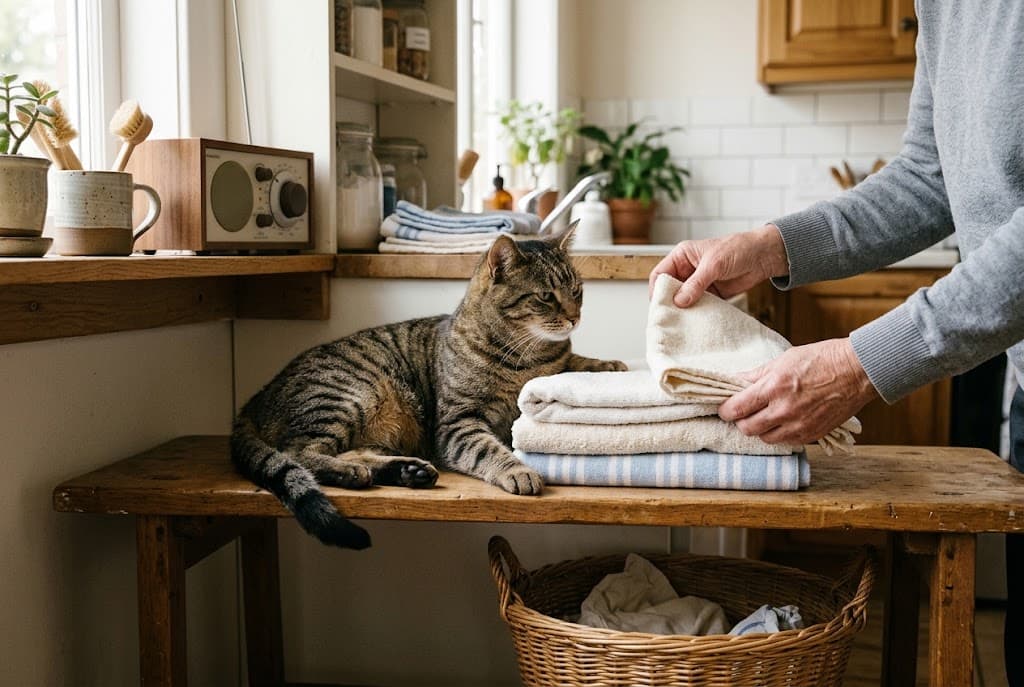
This was playing while I folded the towels. You kept settling onto the warm pile before I could put it away.
That is an invented example of a memory note, not a lyric or a real customer story. Your own detail might be entirely different. Keep what actually happened, rather than borrowing a scene because it sounds touching.
A cheerful song can belong here. So can a piece that seems unremarkable to anyone else. You are choosing something connected with your pet, not submitting a perfect musical explanation of the relationship.
Make a small playlist that leaves room for their life
You could begin with just three choices:
- One song that matches how you feel today.
- One that brings back a particular ordinary moment.
- One you would like to hear beside a happier photograph or story.
These do not need to be three different moods, and you do not have to find all three now.
Beside each title, add a short note about why it belongs. “This reminds me of you” is a beginning. “This was playing on Sunday mornings while you waited by the kitchen” keeps something more specific—if that is what you genuinely remember.
For a private remembrance, you can listen through your usual music service while looking through photographs. You do not need to edit a video or create anything polished.
If you want a few words to accompany a photograph, our original pet memorial quotes offer another starting point. You can write a sentence of your own instead of borrowing a line from a song.
And if you later want to share a video publicly, check the music-use permissions separately. A recommendation to listen is not permission to republish a recording.
What if listening feels like too much?
You can stop halfway through a song. You can remove a track you chose yesterday. You can keep the playlist without opening it for a while.
Listening does not need to become a task you complete correctly. Crying is not the test of whether a song matters, and a day when you cannot bear to hear it does not cancel the memory attached to it.
If you want company, you could ask someone who knew your pet to listen with you—or ask them to tell you which song they remember from that time. You can also keep the whole thing private.
For the parts of the day that music does not help with, How to Cope With Pet Loss, One Ordinary Day at a Time offers practical, non-clinical suggestions beyond choosing something to listen to.
There may never be one song that holds everything: the goodbye, the gratitude, the ridiculous habits, the years of ordinary company.
You do not have to find it.
For now, you can choose one recording and one true moment. The song can end without becoming a final goodbye. What you remembered may be a towel claimed before it was folded, a familiar face turned toward you, or a small interruption you would gladly have again.