How to Write a Tribute to Your Dog That Feels Like Them
By PetMemorium
- Published:
- Last updated:
You open a document to write about your dog, and the first sentence feels far too small.
How is it supposed to hold their particular way of looking at you, their strong opinions about ordinary things, and all those years of sharing a home?
It doesn’t have to hold everything.
A tribute to your dog can begin with a few things you know well: how you came to know them, a moment that shows their character, and something you want to say now. The aim is not to produce the most beautiful piece anyone has written about a dog. It is to help someone meet yours—or to leave yourself a page that feels familiar when you return to it.
You can write for family, for a shared memorial, or for nobody but yourself. If you only want a sentence for a photograph or a brief note, these original pet memorial quotes offer a shorter starting point. Here, we’ll work toward a complete piece of prose.

Where do I start if I can’t find the words?
Start somewhere other than the opening.
An opening has a lot of responsibility when the rest of the page is empty. Notes don’t. Write down whatever comes clearly, without deciding yet whether it belongs in the finished tribute.
You could begin with:
- The first day you remember being together.
- A preference so particular that everyone in the household knew about it.
- An ordinary incident you still find yourself telling people.
- Something you miss doing with them—not just something you miss looking at.
Fragments are useful. You don’t need to explain the whole memory immediately. A few rough words can give you something to return to.
Keep a question mark beside anything uncertain. If you don’t remember the exact year, conversation, or sequence of events, leave room for that uncertainty rather than making the story tidier than it was.
These are working notes, not a test of how much you remember.
How can I introduce the dog I actually knew?
The first time you met can make a natural beginning. There may have been an awkward introduction, a journey home, or a small surprise that seems especially fitting now.
But that first meeting is an option, not a requirement. You might have been too young to remember it. Your clearest beginning might be a much later afternoon.
Choose a moment that lets your dog enter the page as an individual. Give the reader enough background to understand the scene, then let something happen.
You don’t need a dramatic rescue story or a complete account of their early life. Nor do you have to begin with the day they died. A tribute can start while they are doing something utterly ordinary, very much themselves.
Decide whether you want to write about your dog or speak directly to them. Either can work. Choose the voice that lets you say what you mean, and give yourself permission to keep it plain.
Which memories belong in the tribute?
You will probably have more material than one piece needs. Selecting a few memories is not a judgment about the importance of all the others.
Look for scenes that contribute different things.
One might show your dog’s personality: their curiosity, determination, reserve, or peculiar sense of timing. Another might show the shape of your relationship—what you regularly did together, and how their presence became part of that time.
If two stories make essentially the same point, keep the one you can tell more clearly. Give the other a place in your notes.
Within a scene, allow enough space for the action to unfold. Then explain why you have kept returning to it. That connection helps a tribute become more than a collection of amusing incidents.
You also need a way to move between memories. Sometimes a simple change in time is enough: the first weeks at home, then the familiar life you built together. Sometimes a recurring habit provides the connection.
You don’t have to march through every year. What matters is that the next paragraph feels connected to the dog we are getting to know.
How do I write about missing them—and find an ending?
When you reach what you miss, stay close to the life you have described.
What has changed in an ordinary part of your day? What used to involve two of you? What small inconvenience would you gladly have back?
You can acknowledge the awkward habits as well as the lovely ones. Your dog does not have to become faultless to be worth remembering.
Gratitude can be equally specific. Think about something you were glad to share, rather than searching for a grand lesson your dog was supposed to teach you. You can thank them for their company without turning their life into a message.
For the ending, return to an image from the beginning, name something you want to keep remembering, or speak directly to your dog.
You do not need to declare that you have found peace. You do not have to write a final goodbye if that is not what you want to say. The piece can end while the relationship still matters to you.
A complete example: a tribute to Otis
The following is an original, fictional writing example. Otis and these events are invented; this is not a customer’s story or the author’s personal experience.
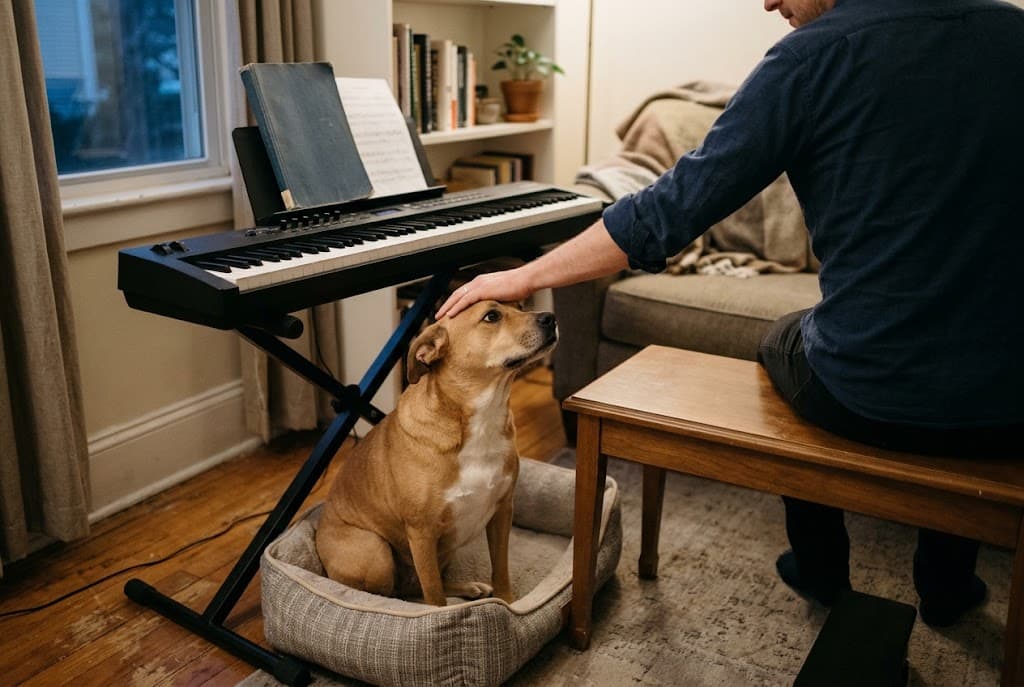
For Otis, Who Kept Me Company
The first time I met you, Otis, I sat on the floor of the rescue center with my hand held out. You gave it a brief sniff, walked past me, and stretched out in a square of sunlight. I had arrived full of nervous plans. You had found a comfortable spot. That turned out to be a fair introduction to both of us.
When I began learning the keyboard, your bed went beside the bench. I was learning three simple songs and playing all of them badly. You would turn around twice, settle with your back against the edge of the bed, and sleep through the parts I had to start again. I began to think of that hour as ours, although it would have been generous to call it a concert.
One evening, several pages slid off the music stand and landed over your paws. You opened your eyes, lifted one foot, and waited while I collected them. Then you lowered your chin and went back to sleep. I remember laughing more clearly than I remember what I was trying to play. Nothing important had happened. It was simply an evening at home with you, and now I would give a great deal to have it back.
The end of practice was another matter. At the soft clap of the music book closing, your head came up. You got out of bed, stretched, and stood by the bench until I reached down. I had spent the hour looking at the keys. Now there was a warm head beneath my hand. As far as I could tell, the song was not the attraction. You knew what came next.
I miss you, Otis. I miss having to step around your bed, and the way an ordinary hour became time we shared. Thank you for all the evenings you spent close by, without needing them to be more exciting than they were.
When I think of you, I still return to that first patch of sunlight. You were not in any hurry to impress me. You made yourself comfortable, and in time I became part of that comfortable world. I am so glad I got to be there.
How do I make the tribute my own?
Borrow the example’s approach, not its events.
The opening introduces Otis through an encounter. The middle gives his company a particular setting and lets one small incident unfold. The ending grows out of that shared time, then returns to the first meeting.
Your dog might need a different shape. You could begin with a later scene, move back to how your life together started, and finish in the present. You might have one central story rather than two.
Put the example aside before writing your own draft. Don’t simply replace Otis’s name and carry over a life that was not your dog’s.
Once you have a complete draft, make a few decisions about the whole piece:
- Does each paragraph add something? Combine passages that repeat the same description or feeling.
- Can someone follow the movement between memories? Add a little context where a jump only makes sense to you.
- Does the dog on the page feel recognizable? Keep the preferences and imperfect habits that stop the tribute from becoming a portrait of any beloved dog.
- Is the ending something you actually want to say? You can remove a polished sentence if it asks you to feel something you don’t.
If the draft feels too exposing to share, keep it private. Finishing and publishing are separate decisions.
When you are ready, you can leave the tribute as it is, put it beside a photograph, or choose another way to keep it. These dog memorial ideas explore different options without requiring you to buy anything.
The page does not have to contain your dog’s whole life. It can hold one afternoon, one familiar habit, and the words you have for them today. That is enough to make it yours.