Dog Memorial Ideas: Choosing a Way to Remember Them
By PetMemorium
- Published:
- Last updated:
The photograph you want to keep beside you might not be the sharpest one. It might be the picture with your dog’s nose too close to the camera, looking exactly as curious and inconvenient as you remember.
Choosing a way to remember them can begin there: with something you recognize.
If you are looking for dog memorial ideas, consider what you want to return to—a familiar face, a shared story, an ordinary object, or a collection that can keep growing. Then choose a form that suits how you want to live with that memory.
You do not need to buy something or make a record of their entire life. These approaches can work for a dog, a cat, or another pet. What makes the choice personal is the connection to the one you knew.
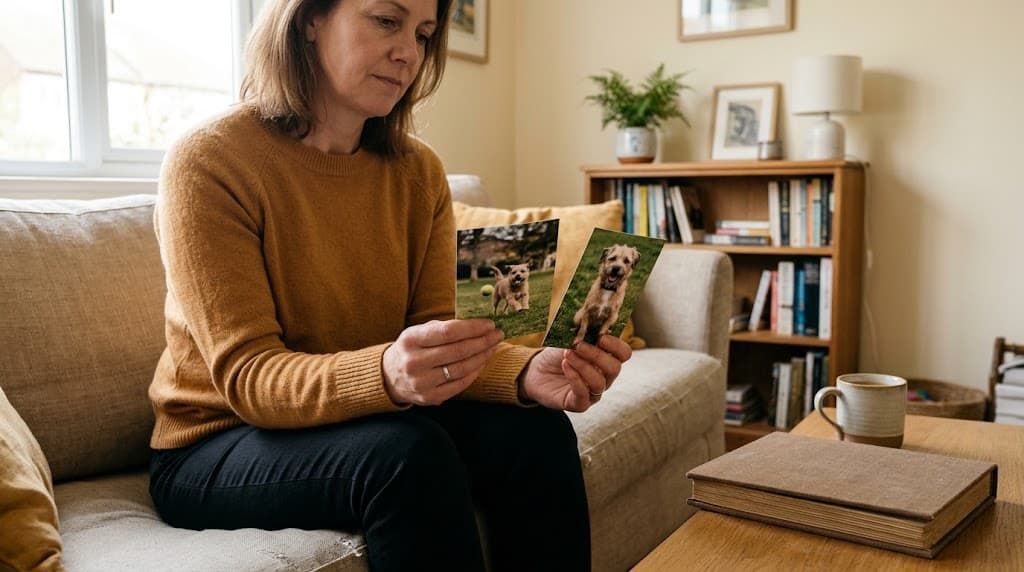
Start with how you want the memory to fit into your life
Before choosing a format, think about what you would actually enjoy using.
Would you like to see something as you pass through a room? Would you rather open a collection only when you feel like remembering? Do you want somewhere to add stories later, or something small that can feel finished?
Consider privacy, too. A photograph in a hallway invites different conversations from a notebook kept in a drawer. Neither choice says more about how much your pet mattered.
Start with what you already have and the amount of attention you want to give the project. A single picture can suit you better than an album you feel obliged to complete.
The aim is to choose somewhere you would want to return—not another thing you need to keep up with.
Keep one photograph with the story around it
A photograph is a good starting point if what you most want is to see a familiar expression, posture, or face.
Choose a picture that feels recognizable to you. It does not need to be the most flattering photograph or the one other people would select.
Then decide whether it needs a little context.
For an invented example, a photograph of a muddy dog on a patio might have a short caption:
“You found the only puddle on the whole walk.”
The photograph holds the muddy paws. The sentence holds what made you take the picture.
You could use a frame you already own, keep the image in a small album, or make a digital folder easy to find. If a visible photograph feels like more than you want in the room, an album or private folder lets you choose when to open it.
You can begin with one image. There is no requirement to turn it into a book.
Choose stories when the important part happened outside the frame
Some of what you remember most may never have looked remarkable in a photograph.
The dog who carefully removed clean socks from the laundry basket. The cat who joined a conversation, made one brief sound, and left again. These are possible examples; your pet’s particular habits may have been completely different.
A small story collection gives those things room.
Start with a story you already tell, rather than trying to write a biography. Give it a title you will recognize later: “The laundry basket,” or “Her contribution to every conversation.”
A notebook, an ordinary document, or a few separate notes can all work. This format may suit you if you want to return to what life together was like, not only what your pet looked like.
You do not need photographs to make it worthwhile. For a fuller, cat-focused guide to remembering without pictures, Remembering My Cat Without Photos: What Can I Keep? explores ways to begin.
Here, the choice is simply whether stories feel like the right home for the memories you want to keep.
Keep an ordinary object if you want something tangible
An object can matter because it was part of your pet’s actual life.
A worn tag, a brush, or a small toy may bring something specific to mind. The important part is not whether it looks special. It is whether you know why you want to keep it.
Choose one thing and its connection. You might keep the toy your dog carried upstairs, rather than every toy they owned. A brief note beside it can explain that choice.
The object can stay in a drawer, a small container, or somewhere you enjoy seeing it. You do not have to put it on display.
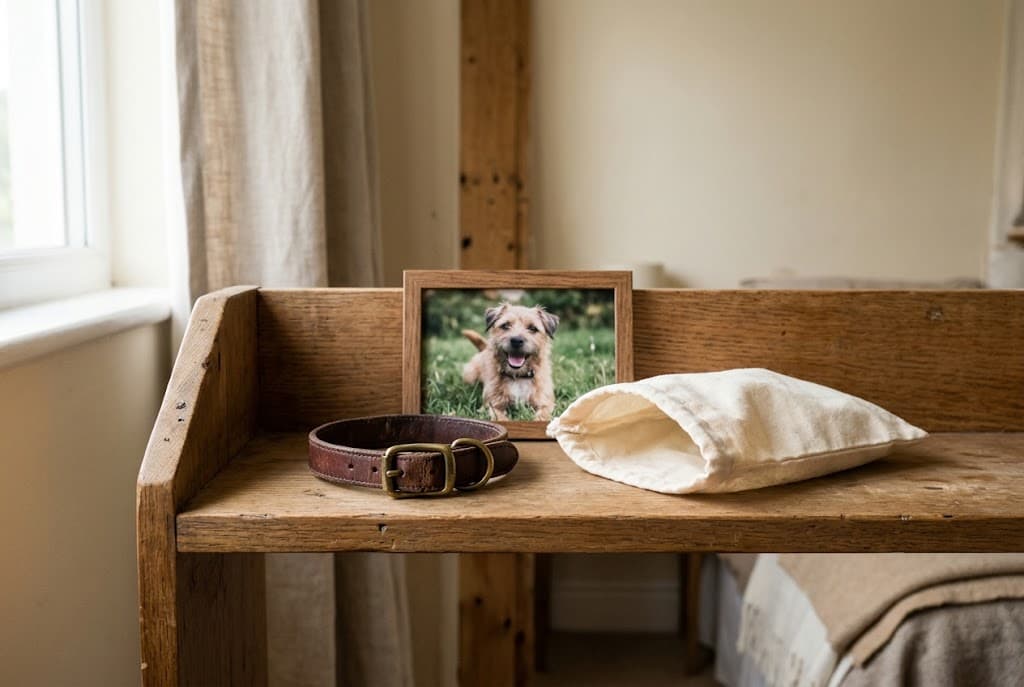
If you would like to see a few related pieces together, a shadow box—a display frame with depth—can be one option. It suits someone who wants a small visual arrangement, rather than a collection to open and browse.
You do not need to buy a substitute for a belonging you no longer have. Another format can hold the memory without pretending to replace the original object.
Leave room for a collection that can grow
You may have photographs, stories, and a few remembered habits without wanting to choose just one kind of record.
An open-ended collection can hold them together.
Begin with a small folder, album, or private online space. Add the photograph you keep returning to and one story that belongs beside it. Let the next addition come when there is something you actually want to add.
This can also suit a pet who shared life with several people. Someone else may have a photograph or a story from a moment you did not see. Ask before adding or sharing their contribution, and keep it clear whose recollection it is.
A collection does not have to become public. Nor does it need a complete timeline. You can organize it around the parts of your pet’s life you most want to revisit: games, funny interruptions, familiar routines, or the people they knew.
How can I choose without making it a huge project?
Try the smallest version of the option you are considering.
Before planning an album, choose one photograph. Before deciding on a display, set aside the object you want it to hold. Before starting a collection, save the story that made you want one.
Then ask whether the form fits the way you want to remember.
Do you like having it in sight? Would you prefer something private? Is there a place for the memory’s personal detail, or does the format leave that part out?
You can change your choice. You can also keep two simple things instead of combining everything into one project.
There is no need to make the result look like someone else’s memorial.
The photograph with the nose too close to the camera can be enough. So can the story you always tell, or the small object you recognize by touch.
Choose the part that makes you think, Yes. That was them.
Give that part somewhere to stay.