Dreaming of a Deceased Pet: Why Those Dreams Can Feel So Real
By PetMemorium
- Published:
- Last updated:
Dreaming of a deceased pet can be part of the experience of grieving. Cornell University’s veterinary college specifically notes that people missing a pet may dream about the animal who has died. It is a documented experience, not something you have to explain away or feel embarrassed about. Read Cornell’s description.
What can be harder to understand is the morning afterward.
You may wake with a familiar detail still close: the movement of an ear, a small sound, the way your pet leaned against you. For a moment, the ordinary life you shared seems within reach. Then you remember why seeing them felt so unexpected.
A dream can leave you glad, shaken, or missing them all over again. Understanding it does not require choosing between “it meant nothing” and “it must have been a visit.” There is room to take the experience seriously without claiming to know more than we do.

Why would I dream about a pet who has died?
Your pet was part of your waking life—often in repeated, ordinary ways. Their death does not remove those memories or the feelings attached to them. A dream involving them can be understood in that context, although it does not have one explanation that applies to everyone.
Research has recorded these experiences, too. An exploratory report in the 2025 volume of Dreaming examined reports from people who had lost a partner and people who had lost a dog or cat. It considered both dreams and experiences reported while awake. Recording such experiences is not the same as establishing their cause or proving contact with the deceased. See the research abstract and publication details.
It would be too simple to say that every pet dream is your mind “giving you closure,” working through one particular feeling, or telling you that you are ready to move on.
Some dreams may remind you of something you have been thinking about. Others can seem disconnected from the day you just had. A familiar pet may appear in a place they never visited, or behave in a way they never did.
You can notice what the dream brought up without treating every detail as a message that needs decoding.
Why can the dream feel so familiar?
Sometimes the striking part is not the story. It is the recognition.
Consider two imagined scenes, offered only as examples. In one, a dog gives the same little shake before settling down, one ear briefly turned inside out. In another, a cat places a paw on the loose end of a robe belt while their person ties it.
Neither scene needs a dramatic reunion. The movement itself feels recognizable.
There is also a general sleep-related reason not to be surprised by vividness. NIH explains that dreams are generally most vivid during REM sleep, although dreaming also occurs during non-REM sleep. Scientists still do not fully understand why we dream. That background does not identify the sleep stage or cause of your particular pet dream. Read NIH’s explanation of dreaming.
A dream can feel convincing while you are in it. That feeling alone cannot establish that the scene happened outside the dream.
Some people understand a meaningful dream through their faith or personal beliefs. Others experience it as a vivid encounter with memory and longing. You do not have to dismiss the comfort it gave you, and you do not have to present a spiritual interpretation as something research has verified.
“I’m glad I dreamed about them” can be a complete response. You are allowed to leave some questions unanswered.
Why can waking up feel comforting and painful?
In a comforting dream, the missing part of everyday life may briefly seem present again. Waking restores the difference between what you experienced in sleep and what is happening now.
You might feel grateful for the familiar moment and upset that it ended. One feeling does not cancel the other.
Nor does a difficult morning automatically mean you have gone backward. Cornell’s pet-loss resources describe grief as individual and without a prescribed timeline; feelings can change from day to day or moment to moment. A dream is not a progress report on how well you are grieving. Read Cornell’s pet-loss support information.
Before trying to interpret the whole experience, you could attend to the morning in front of you. Sit up, turn on a light, have some water, or give yourself a little time before opening your messages. These are ordinary options, not a treatment or a way to make the sadness disappear.
If you want company, you can tell someone plainly: “I dreamed about them last night, and waking up was hard.” You do not need to make the dream sound uplifting to share it.
For help with the practical demands of the day, How to Cope With Pet Loss, One Ordinary Day at a Time offers a separate, gentle starting point.
What if the dream is upsetting?
Not every dream brings back a happy version of your pet. You might dream that they are ill, that you cannot reach them, or that they leave before you can do anything.
Those scenes can be distressing. They do not, by themselves, establish that your pet is suffering now, that something bad will happen, or that you made a wrong decision in real life.
A dream is not a medical record or a reliable account of your pet’s thoughts. If it raises a factual question about their illness or care, the useful evidence comes from what actually happened and, where appropriate, a conversation with the veterinarian involved—not from interpreting the dream.
You also do not have to search for a hidden lesson in the most painful image. You can describe your reaction more simply: “That frightened me,” “I missed them when I woke up,” or “It brought back a question I still have.”
Writing the dream down is optional. If you would rather leave it unwritten, that is a choice you can make.
If distressing dreams repeatedly interfere with sleep or daily life, consider talking with a qualified health professional or a bereavement counselor. Asking for support does not require you to diagnose yourself or decide what the dream “really means.”
What if I never dream about my pet?
Not remembering a dream about your pet is not evidence that you loved them less.
Dream researcher Joshua Black’s educational FAQ describes wide differences in how often people report dreams of the deceased, including people who report none. It also distinguishes wanting such a dream from being able to recall dreams generally. Read the researcher’s explanation.
Not remembering a dream is also different from knowing that no dream occurred.
It is understandable to wish for one familiar moment in sleep, especially after hearing someone else describe theirs. But another person’s dream does not set a standard your relationship has to meet.
There is no dream you need to produce as proof. The dog you learned to walk beside, the cat whose preferences you came to recognize, and the life you shared do not become less real because your nights are quiet.
You can keep a memory while awake without waiting for a dream to give you permission.
How can I keep what the dream brought back without treating it as fact?
A dream can remind you of a real habit. It can also introduce places, actions, or conversations that were never part of your pet’s life.
If you want to write something down, keep those two things separate.
Keep a dream note, if you want one
Label it clearly as a dream, and record only what you remember of it. You can include how it felt without claiming that its events actually happened.
For an invented example:
In the dream, you were in my old classroom. You put a paw on the end of my robe belt.
That is a record of a dream. It does not establish that the cat visited the classroom, or that everything in the scene came from a real event.
Fragments are enough. If you remember the gesture but not the setting, you can say exactly that instead of filling in the missing parts.
Make a separate real-life memory
Now ask: What, if anything, does this remind me of that actually happened?
Continuing the fictional example, the person might genuinely remember:
At home, you sometimes stood beside me and held down the loose belt with one paw while I tied my robe.
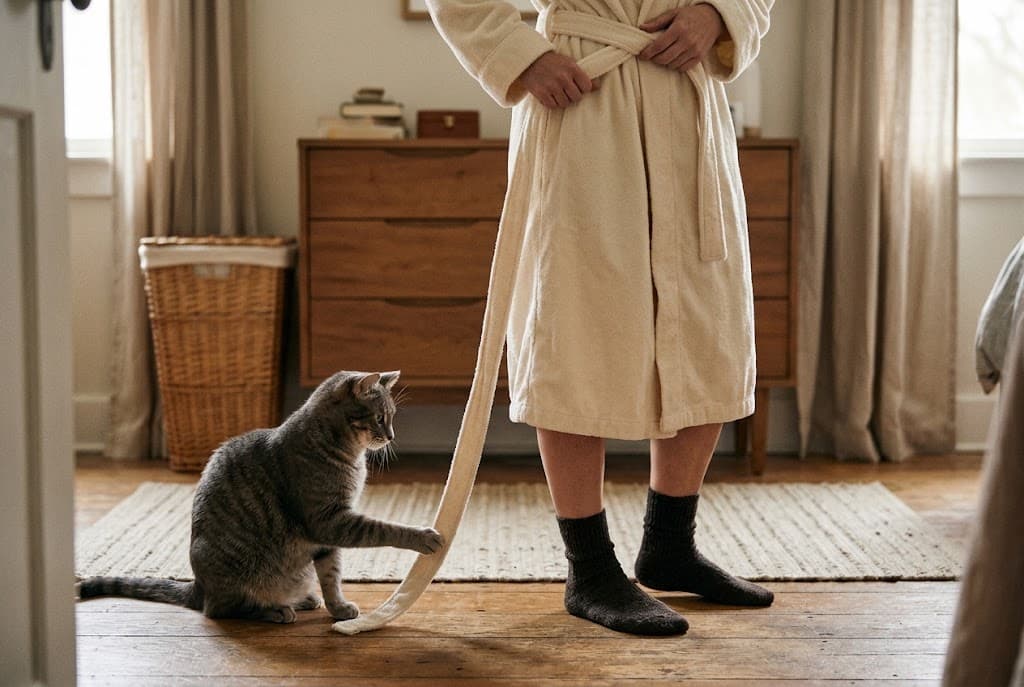
The classroom belongs to the dream. The familiar behavior belongs in the real-life record only if the person independently remembers it happening.
Your own note may be about a different action entirely: how your dog waited for you to finish a task, a sound your cat made, or an ordinary exchange you had almost stopped noticing.
If you are unsure whether a detail happened outside the dream, leave it marked as uncertain. If all you have is the dream, it can remain a dream note. There is no need to turn it into a memory.
You do not need a photograph to begin preserving a true detail. Remembering My Cat Without Photos explores other ways to keep what you remember without inventing what is missing.
You can treasure a dream without asking it to answer every question.
You can also feel unsettled by one, choose not to record it, or go a long time without remembering any dreams at all. None of those experiences has to become a judgment on the relationship.
If one familiar movement stays with you this morning, you can pause over it. If it brings back a real moment, keep that moment in its own words.
The dream may have placed your pet somewhere impossible. The small thing you recognize can lead you back to the ordinary life you actually shared.