Day of the Dead for Pets: October 27 and How to Make an Ofrenda
By PetMemorium
- Published:
- Last updated:
October 27 is a widely observed date for remembering deceased pets during Mexico’s Día de Muertos season. It is not a single calendar followed by every Mexican household. Mexico’s ISSSTE identifies October 27 with pet remembrance while also acknowledging different beliefs about when the departed return. Read ISSSTE’s explanation.
If you are thinking about making a pet ofrenda, you do not have to begin with an elaborate arrangement. Begin by understanding the tradition—and by thinking about the particular animal you want to remember.
Which photograph makes you recognize their expression immediately? Which ordinary object still brings back something they used to do?
Those questions can help you make a small space that holds more than a collection of decorations.
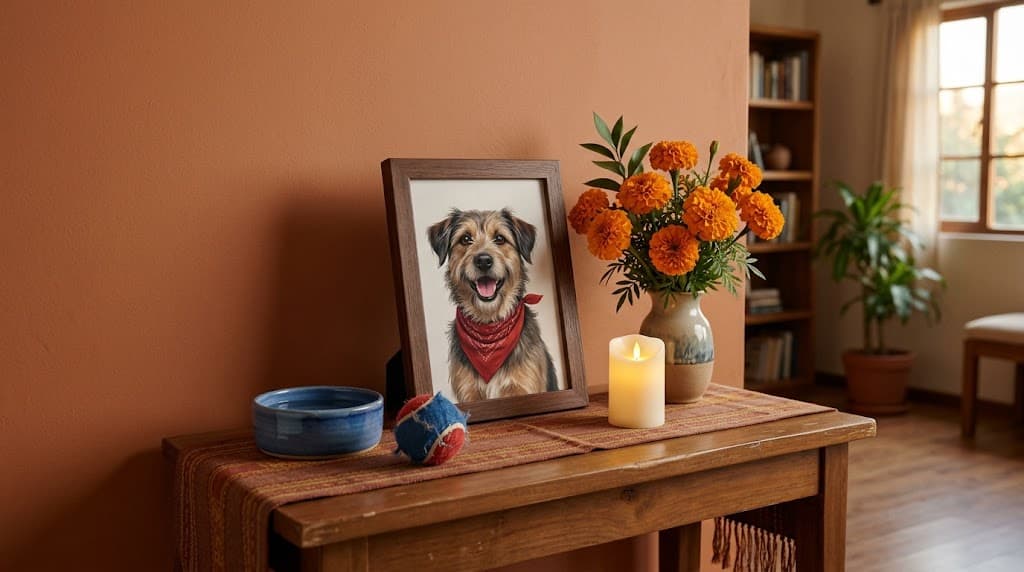
Why do many families remember pets on October 27?
October 27 appears in a popular remembrance calendar ahead of the better-known November 1 and 2 observances. Some families include pets on that date; others follow different household or community customs. There is no single schedule that describes everyone’s practice.
The wider tradition of Día de Muertos has deep cultural roots. UNESCO describes the Indigenous Mexican observance as bringing together pre-Hispanic religious traditions and Catholic feast days, with festivities occurring from late October into early November. Within these traditions, the temporary return of departed loved ones is a matter of belief. See UNESCO’s cultural description.
That history should not be taken to mean that every part of today’s pet-specific calendar is equally old. October 27 is best introduced as a date used in contemporary pet remembrance, not as proof of an ancient, nationally uniform pet holiday.
For someone preparing an ofrenda now, the useful distinction is simple: you can recognize the commonly observed pet date while respecting that another family may mark the season differently.
What is an ofrenda?
An ofrenda is an offering, or an arrangement of offerings, often placed on a home altar for Día de Muertos. It carries cultural and, for many families, spiritual meaning. It is more than a decorative display.
Mexico City’s cultural guide describes families talking, praying, and recounting the lives of the people being honored as they prepare their ofrendas. Read the guide to ofrendas.
A pet-focused arrangement can similarly bring attention to a life that was part of the household: the dog who carried a toy from room to room, or the cat who came to investigate whenever a drawer opened.
You do not need to make your pet’s life sound grander than it was. Their ordinary place in your home is already worth remembering.
How can I make a small, personal pet ofrenda?
The suggestions below describe one modest home arrangement. They are not a universal ritual checklist. If you follow a family or community tradition, let that tradition guide your choices.
1. Choose a stable place with room to see what you have kept
A small table or a secure, accessible shelf can give the arrangement a clear place without taking over a room.
Start with a surface you already have. Leave enough room between objects that a photograph, a water bowl, and a favorite toy can each be seen. You do not need to build tiers or buy a special stand for this simple version.
Choose somewhere you can pause comfortably, rather than a spot that only looks impressive in a photograph. Keep walkways and exits clear.
2. Begin with a photograph—or their name
Choose a photograph because it feels recognizable, not because it is the most polished one.
An awkward sleeping position, a familiar sideways glance, or a face partly hidden behind a toy may say more about your pet than a perfect portrait.
If you do not have a photograph, you can begin with their name and an object or written memory. You do not need to substitute a picture of another animal or invent details you cannot remember.
Our guide to remembering a cat without photos offers other ways to preserve a pet’s individuality when pictures are missing.
3. Choose an object because of what happened around it
A collar, a worn toy, or a familiar blanket can belong here because of its connection to your pet—not because it looks like a memorial item.
Before adding something, finish this sentence:
I remember this because you used to…
For a made-up example, imagine a dog who carried a soft ball to the kitchen but never dropped it until someone looked down. The ball could sit beside a note about that small, patient negotiation.
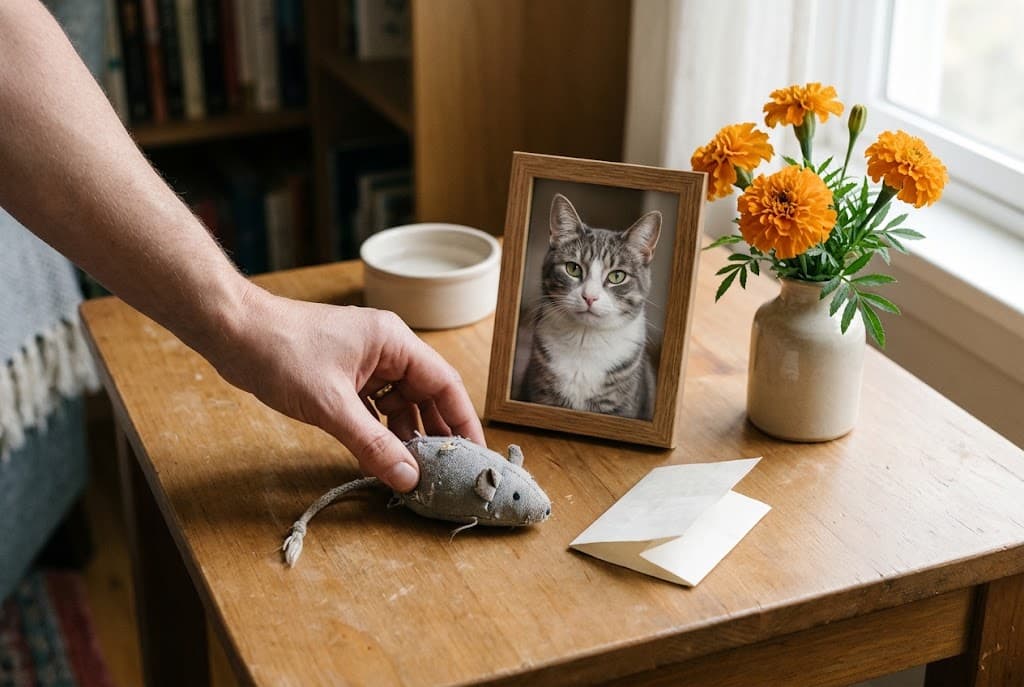
For a cat, the meaningful object might be an old toy mouse that repeatedly appeared in the laundry basket. If that was your cat’s actual habit, the story is what makes the object theirs.
If you no longer have the object, write down the memory instead. There is no need to purchase a replacement and pretend it carries the same history.
4. Understand the offerings you choose
Water has a traditional place in an ofrenda: it is offered to ease the thirst of the departed after their journey. Familiar foods express welcome through what the person enjoyed in life. These meanings belong to the tradition’s beliefs, not to a scientifically established account of what happens after death. Mexico City’s guide explains these elements.
For a pet arrangement, you might choose a small bowl of water and a modest symbolic portion of food your pet actually enjoyed. Keep the arrangement separate from feeding areas used by living animals.
Cempasúchil, the Mexican marigold, is a distinctive Día de Muertos flower. Its scent is traditionally believed to guide the departed toward the ofrenda. Understanding that meaning matters more than treating orange flowers as interchangeable seasonal decoration. SEMARNAT explains the flower’s cultural significance.
If you cannot obtain cempasúchil, you can acknowledge that absence rather than claim another flower has exactly the same traditional meaning. Your small personal arrangement does not need to imitate every feature of a large public altar.
5. Give one object a little of its story
Once the objects are in place, add something that a visitor could not learn by looking alone.
What happened just before the photograph? Why is that toy worn on only one side? What did your pet do when you reached for the collar?
Write a few plain sentences. You do not need a poem or a polished farewell.
A useful starting point is:
This was your ____. You used to ____. What I still remember is ____.
Fill it only with details you genuinely remember. Leave an uncertain detail uncertain.
If you would like help finding a short expression, these original pet memorial quotes also explore how specific habits can give simple words their meaning.
How can I keep the arrangement safe?
For this small home setup, a flameless LED candle is an option if you want light without an open flame. It is a practical adaptation, not a claim that every household gives it the same ritual meaning as a candle.
If you use real candles, place them on stable bases away from paper, fabric, and other flammable materials. Extinguish them before leaving or going to sleep, and never leave a flame unattended. Morelos Civil Protection also advises keeping pets away from altars and keeping escape routes clear. Read its ofrenda safety guidance.
Keep food, flowers, small decorations, and candle equipment out of reach of living pets and young children. Replace food before it spoils, and remove any part of the arrangement that cannot be kept safely.
You do not have to leave anything burning overnight to make the space meaningful.
Can I remember my pet this way without believing that spirits return?
You can make a personal remembrance inspired by the tradition without claiming to know what happens after death. Be clear about that distinction, and acknowledge the Mexican cultural roots rather than presenting the practice as something without a history.
If Día de Muertos is new to you, take time to read Mexican cultural sources and learn what the elements mean. If someone invites you into their family’s observance, ask how they practice it rather than assuming this guide describes their customs.
There is also no need to make your remembrance public. You can keep a small arrangement at home, tell one story to someone who knew your pet, or sit with the objects quietly.
When you later put things away, you can keep the note with the photograph or return the toy to its usual place. Taking down an arrangement does not require you to put the memories away with it.
As you decide what belongs there, look again at the object you chose first. It may be scratched, faded, or rather ordinary to anyone else.
You know why you kept it.
The collar recalls the pause before a walk. The toy recalls a particular game. The photograph recalls a moment just outside its frame. Giving those details some attention can make this small space feel unmistakably connected to the pet you knew.